
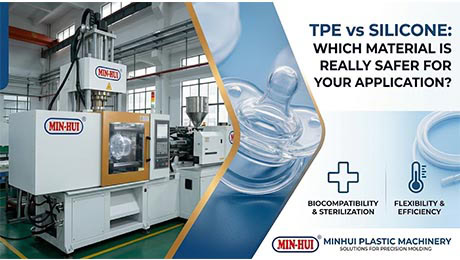
When manufacturing elastomeric parts for sensitive applications—such as surgical instruments, infant pacifiers, or commercial food handling equipment—material safety is non-negotiable. Design engineers and manufacturing teams frequently ask: TPE vs silicone safety: which material truly guarantees long-term compliance and safety?
While Thermoplastic Elastomers (TPE) and Liquid Silicone Rubber (LSR) both offer flexible, rubber-like properties, their chemical structures fundamentally alter their biological, thermal, and chemical performance. This comprehensive TPE vs silicone comparison evaluates key safety metrics to help you choose the right material and processing equipment for high-standard applications.
Comparing TPE and Silicone Safety Pillars
Evaluating TPE vs silicone safety requires looking closely at four critical material properties.
1. Biocompatibility & Cytotoxicity (ISO 10993 & USP Class VI)
- Liquid Silicone Rubber (LSR): Platinum-cured liquid silicone is inorganic and chemically inert. It features minimal extractables and leachables, making it the global gold standard for long-term implantable devices, respiratory masks, and infant products. It naturally satisfies ISO 10993 (cytotoxicity, sensitization, irritation) and USP Class VI requirements.
- Thermoplastic Elastomers (TPE): High-grade medical TPEs can achieve USP Class VI certification. However, because TPE relies on an organic carbon-carbon polymer chain that often includes processing oils or stabilizers, improper formulation or processing can result in additive leaching over time.
2. Thermal Stability & Sterilization Performance
- Silicone: Silicone maintains its mechanical integrity and biological safety from -60°C up to +250°C. It tolerates repeated high-pressure steam autoclaving, gamma radiation, and ethylene oxide (EtO) sterilization without hardening, warping, or off-gassing.
- TPE: TPE melts under heat (softening between 80°C and 130°C). While suitable for single-use devices sterilized via EtO or gamma radiation, standard TPE cannot endure repeated steam autoclaving.
3. Chemical Stability & Leachables
- Silicone: Highly resistant to UV radiation, ozone, oxidation, and aggressive cleaning agents. It emits no harmful volatile organic compounds (VOCs).
- TPE: Resistant to dilute acids and alkalis, but sensitive to non-polar solvents and oils. Lower-grade TPE or TPR compounds may leach mineral oils under continuous chemical exposure.
4. Regulatory Compliance: FDA & Medical-Grade Certifications
Navigating regulatory standards is essential for global market access:
- FDA Compliance: Silicone meets FDA 21 CFR 177.2600 for rubber articles intended for repeated food contact, while TPE complies with FDA 21 CFR 177.1210. Silicone exhibits lower overall migration limits when in contact with fatty foods and oils.
- Medical-Grade Certifications: Liquid silicone naturally meets strict biocompatibility criteria without plasticizers, phthalates, or Bisphenol A (BPA). Medical TPE requires specialized, additive-free compounding to pass medical audit standards.
Application-Specific Safety Requirements
Medical Devices: Silicone vs TPE for Medical
When evaluating silicone vs TPE for medical products, usage duration determines the choice:
- Silicone (LSR): Preferred for long-term implantables, surgical tubing, and reusable ventilator masks requiring repeated steam sterilization.
- Medical TPE: Ideal for single-use or short-contact items, such as syringe seals, fluid bags, and diagnostic tubing, reducing sterilization costs.
Infant & Baby Care Products
Infant teethers and nipples face continuous exposure to saliva and boiling water.
- LSR Silicone: Non-porous surface prevents bacterial growth and resists tearing from infant biting while enduring dishwasher sterilization.
- TPE: Used for soft handles and spoon grips, requiring strict formulation controls to ensure zero plasticizer leaching.
Food-Contact Applications
Both materials offer FDA-compliant options. However, liquid silicone is preferred for high-temperature baking molds, coffee machine seals, and beverage lines due to zero flavor transfer.
How MINHUI Machinery Guarantees Material Safety
Material formulation is only part of the safety equation—precision manufacturing completes it. Thermal degradation or cross-contamination during injection molding can compromise raw material integrity.
- MINHUI Plastic Machinery offers specialized processing equipment tailored to high-safety materials:
- MINHUI Precision LSR Injection Molding Machines: Designed specifically for liquid silicone rubber molding, our LSR systems feature closed-loop liquid dosing pumps, cold runner valve-gate systems, and precise clamping units. This prevents contamination, ensures exact 1:1 A/B component mixing, and eliminates micro-flashing for cleanroom medical production.
- MINHUI TPE Injection Molding Systems: Engineered with precise multi-zone temperature control and low-shear screw geometry, MINHUI TPE machines prevent thermal degradation and phase separation during high-speed production runs.
Which Is Safer?
- Choose Liquid Silicone Rubber (LSR) if your product demands repeated steam sterilization, long-term biological contact, zero flavor transfer, and extreme heat resistance.
- Choose TPE if your application involves single-use medical consumables, complex multi-material overmolding, low heat exposure, and where 100% recyclability is required.
Partnering with the right machinery supplier ensures your material’s safety integrity remains intact from raw resin to finished part. Explore MINHUI’s advanced LSR injection molding machinery to upgrade your high-precision production line today.

