
Running a manufacturing business is no easy feat. While some people chase quick returns through speculation, manufacturers grind through long production cycles, tight margins, and complex supply chains — only to find that choosing the wrong injection molding machine supplier can set an entire project back by months.
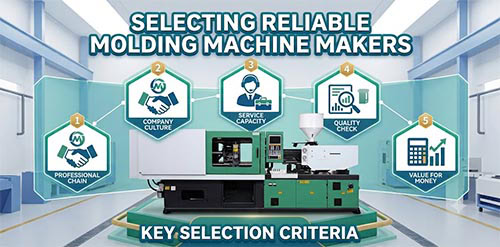
So how do you find a manufacturer you can genuinely rely on? The good news is that it comes down to five clear criteria. Get these right, and you will rarely end up with a supplier that lets you down.
1. Professional Capability: Can They Handle the Full Production Chain?
The first thing to assess is whether the manufacturer offers end-to-end capability — not just machine assembly, but the complete chain from design and engineering to component machining, welding, assembly, painting, electronic control systems, finished product integration, quality assurance, and after-sales support.
This matters for a practical reason: when a single manufacturer controls the entire process, coordination costs drop to near zero. Problems are easier to trace, and responsibility is clearly defined. The moment you introduce multiple subcontractors, you introduce friction — and in manufacturing, friction almost always turns into delays and finger-pointing.
What to look for:
- A full-service workshop covering mechanical, electrical, and surface treatment processes
- Documented production workflows with clear handoff points between departments
- Case studies showing projects taken from prototype to mass production
2. Company Culture: The Differentiator You Cannot See on a Spec Sheet
Most buyers focus on hardware. But here is a reality that experienced procurement professionals know well: among manufacturers in the same price tier, the hardware gap is usually small. The real gap is in culture, discipline, and how a team actually operates day to day.
A manufacturer with a strong internal culture will have a clearly defined mission, consistent values, and working methods that do not rely on any single person. Their production floor management will not just be a “5S” poster on the wall — it will be visible in how employees handle materials, how workstations are organized, and how teams communicate when something goes wrong.
During a factory visit, pay attention to:
- Whether employees can articulate the quality standard for their own workstation
- Whether management is willing to give you a full, unscripted tour of the facility
- Whether written process standards and internal quality manuals actually exist and are in use
Culture is slow to build and nearly impossible to fake during a real visit. It is one of the most reliable signals of long-term reliability.
3. Service Capability: Real Service Happens Before Problems Appear
“Pre-sale, in-sale, and after-sale support” is the baseline, not the standard. What actually separates good manufacturers from great ones is whether they anticipate your needs rather than simply react to them.
A proactive service mindset looks like this: the manufacturer flags a potential delivery risk two weeks before a deadline, not the day before. The technical team sends a complete confirmation checklist at the start of a project rather than waiting to be asked. When something goes wrong — and in manufacturing, something always eventually goes wrong — the response is active problem-solving, not passive waiting.
Green flags to watch for:
- During the first conversation, they ask about your application scenario, output targets, and quality requirements before jumping to pricing
- They provide milestone-based project updates without being prompted
- They have a defined escalation process with clear response time commitments
Red flags:
- Vague answers about delivery timelines
- No structured onboarding process for new orders
- After-sales support that only activates when you make noise
4. Quality Verification: Let Data and Samples Do the Talking
No manufacturer will tell you their quality is poor. That is why you should never rely on verbal assurances alone. Quality must be verified through documented evidence and, where possible, physical testing.
Before committing to a supplier, request inspection reports for recent machines — ideally from the past six months. Ask about the sourcing of key components: hydraulic systems, electronic controls, and clamping mechanisms should come from suppliers with established track records. Understand how they handle non-conforming products during production and what their outgoing quality control process looks like.
A practical verification checklist:
- Recent factory inspection and quality reports (within 6 months)
- Component sourcing documentation for critical parts
- In-process defect rate and handling procedures
- On-site or remote machine testing before final delivery acceptance
If a manufacturer resists any of these requests, that tells you something important.
5. Value for Money: Calculate the Total Cost, Not Just the Invoice
Price is the starting point of the conversation, not the conclusion. True value for money means comparing the full package — product quality, delivery reliability, service responsiveness, technical support, and the cost of potential downtime — against what you are paying.
Geography matters here too. A nearby manufacturer offers advantages in response time, on-site support, and logistics cost that can meaningfully offset a slightly higher unit price. A more distant supplier needs to demonstrate equally strong remote support capability to justify the trade-off.
Once you have evaluated professional capability, company culture, service quality, and product verification, the final price comparison becomes much clearer — because you are comparing equivalent value, not just numbers on a quotation.
Putting It All Together
Finding a reliable injection molding machine manufacturer is not about luck. It is about knowing which questions to ask and which signals to trust. A manufacturer who welcomes scrutiny, backs their claims with data, and demonstrates consistent process discipline is one you can build a long-term partnership with.
At MINHUI, we have built our operation around exactly these standards — from full-chain manufacturing capability to a service model that puts problems in front of you before they become crises. If you are currently evaluating suppliers, we welcome a factory visit or a detailed technical consultation. Let the facility speak for itself.

