
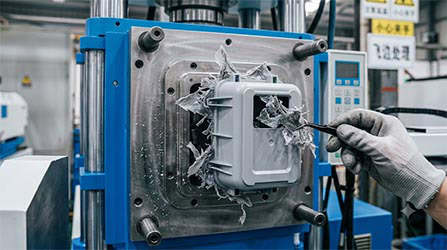
In insert molding or precision component production, vertical injection molding machines are widely utilized for their unique structural advantages. However, flash (also known as burrs, flashing, or overflow) is a highly common and frustrating quality defect in daily production. It not only compromises the product’s appearance and increases manual trimming costs, but severe flash can also permanently damage the mold.
Why does a vertical injection molding machine produce flash? This is usually the result of an intertwined relationship between the mold, the process parameters, and the raw materials. Below, we will analyze the underlying logic of this phenomenon and provide corresponding troubleshooting solutions.
1. Mold Precision and Design Flaws
The clamping direction of a vertical injection molding machine is typically vertical, meaning the mating precision of the mold directly determines whether the molten plastic will escape.
A. Parting Line Damage and Deformation
- Surface Damage: During long-term production, if metal debris or uncleaned plastic residues stick to the parting line, or if protruding prying marks and burrs are left during mold assembly, the mold will fail to close completely.
- Fatigue Clamping: If an old mold frequently withstands high pressure or has been crushed by previous flash overflow, the areas surrounding the cavity will suffer fatigue indentation, creating microscopic gaps.
- Template Deformation: If the moving platens (such as the middle plate) warp or deform under long-term high-pressure impact, it leads to uneven distribution of the clamping force, triggering flash.
B. Suboptimal Runner and Gate Design
- Asymmetric Stress: If the mold cavities are positioned too far off-center, the high-pressure melt will generate an immense opening force on one side during injection, causing the mold to tilt slightly and flash.
- Improper Gate Location: Gates should ideally be located at the symmetrical center of the product or at the thicker sections. Poor placement can cause a situation where one side is underfilled while the other side is already flashing.
- Insufficient Core Support: When a mold features moving cores (sliders) or side components, their projected side areas also bear the brunt of the molding pressure. If the fitting accuracy or locking force is insufficient, the melt will creep into the gaps.
C. Venting Slots and Fit Tolerances
- For materials with excellent fluidity (such as PE, PP, Nylon, etc.), the viscosity is extremely low in the molten state, demanding high manufacturing precision from the mold. If the venting slots are cut too deep or too large, or if poor venting causes high localized pressure that pushes the mold open, flashing will occur.
2. Improper Injection Molding Process Parameters
Process parameters are the primary tools for setup technicians to control flash. Once the balance between the clamping force and the injection pressure is disrupted, flash becomes inevitable.
When: Injection Pressure + Cavity Counter-force > Actual Machine Clamping Force ==> Mold Micro-opens ==> Flash Occurs
A. Excessive Pressure and Speed
- Side Effects of High Pressure/Speed: When the injection pressure is too high or the injection rate is too fast, the impact force of the melt against the cavity walls surges. If this opening force exceeds the set clamping force of the vertical machine, the mold will be forced open slightly, causing material overflow.
- Adjustment Strategy: Control the injection in stages based on the wall thickness. Thin-walled products require high-speed filling that stops the moment it is full; thick-walled products should be filled at lower speeds, allowing the outer skin to mostly solidify before reaching the final pressure.
B. Overcharging (Excessive Feed Weight)
- Many technicians blindly increase the feed dosage or injection stroke to prevent surface sink marks (shrinkage). This approach rarely fixes the sink marks properly; instead, it overfills the cavity and directly jacks the mold open.
- Correct Practice: Shrinkage should be resolved by reasonably extending the injection time or optimizing the holding time and holding pressure, rather than simply packing more material into the barrel.
C. Elevated Temperatures Lowering Viscosity
- Excessive barrel temperature, nozzle temperature, or mold temperature will cause the melt viscosity of the plastic to drop drastically, skyrocketing its fluidity. The overly thin melt can effortlessly penetrate the normal tolerances of the mold components, generating flash.
3. Raw Material Characteristics and Anomalies
The rheological behavior of the raw material is the fundamental physical factor that influences flash.
A. Low Viscosity and High Moisture Content
- Sensitive Material Behavior: Plastics with high inherent fluidity like Nylon (PA) and Polyethylene (PE), or moisture-sensitive plastics, will suffer molecular chain degradation if they contain moisture at high temperatures. This drastically reduces viscosity and spikes the likelihood of flash. Therefore, these plastics must be thoroughly dried before production.
- Excessive Recycled Material: Blending in too much regrind or recycled material alters the overall molecular weight distribution of the plastic, leading to a drop in viscosity. The retention ratio must be adjusted if necessary.
- Note: Conversely, if the plastic viscosity is too high and flow resistance is immense, it can cause localized compression and relative insufficient clamping force, which may also generate flash.
B. Uneven Resin Pellet Size
- If the purchased raw material or self-mixed regrind has inconsistent pellet sizes, the feeding volume into the barrel will fluctuate randomly. Under identical injection parameters, the actual melt volume in the metering chamber will vary, resulting in an alternating cycle of “short shots (underfilling)” and “flash overflow.”
💡 MINHUI Expert Troubleshooting Guide
In actual industrial production, resolving flash on vertical injection molding machines requires a systematic elimination method. As a professional brand in the vertical injection molding industry, MINHUI recommends diagnosing flash defects through the following “easy-to-difficult” steps:
- Check Mold Cleanliness First: Inspect whether there are tiny plastic residues or foreign objects on the parting line to ensure the mold can lock completely airtight.
- Optimize Process Parameters: Appropriately reduce the injection pressure and holding pressure, slow down the first stage of injection speed, or slightly lower the barrel and nozzle temperatures.
- Verify Material Status: Confirm whether the raw material is properly dried, and check the blending ratio and pellet uniformity of the recycled material.
- Evaluate Equipment and Mold Structure: If the above methods fail, verify whether the projected area of the product exceeds the rated clamping force of the machine, or disassemble the mold to re-grind and fit the parting lines and slider clearances.
By balancing the relationship between the “mold, process, and material,” you can efficiently eliminate flash defects, improving both the yield rate and production efficiency of your vertical injection molding operations.

