
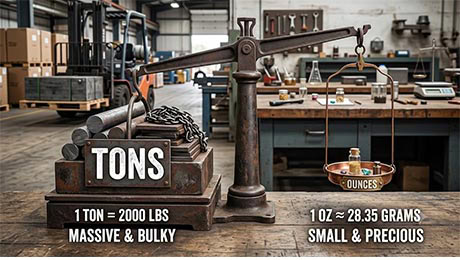
In the manufacturing industry, one of the most common confusion points is the conversion of injection molding tons vs ounces. Many customers often ask: “How many ounces correspond to a 55t machine?” or “What is the tonnage for machines ranging from 4 oz to 24 oz?” These differences actually reflect the industrial standards of different regions.
Understanding Injection Molding Tons vs Ounces
In Mainland China, the industry typically uses “Tons” (T) to distinguish machine models, which represents the Clamping Force. However, in the Hong Kong industrial sector and some southern regions, it is more common to use “Oz” (Ounces)—often referred to as “An” (安)—as the unit. This represents the machine’s Theoretical Shot Weight.
Understanding the logic behind injection molding tons vs ounces is critical for selecting the right equipment. Simply put, a 55t injection molding machine usually corresponds to approx 4 oz.
To help you reference this quickly, we have compiled a common conversion table.
Chart: Injection Molding Tons vs Ounces Conversion
| HK Style (Ounces/Oz) | Mainland Style (Tons/T) | Notes |
| 4 oz | 55T | Common for small precision parts |
| 6 oz | 120T | |
| 8 oz | 140T | |
| 12 oz | 160T | Standard screw diameter approx. 32mm |
| 16 oz | 180T | |
| 18 oz | 200T | |
| 24 oz | 250T |
Note: The data above serves as a general industry conversion reference. Specific values may vary slightly depending on the equipment brand and design.
Deep Dive: Screw Selection and Customization
Beyond looking at tonnage and shot weight, the selection of the Screw is critical in determining injection quality. Taking a 12 oz (160T) injection molding machine as an example, its standard screw diameter is approximately 32mm.
However, in actual production, a machine of the same tonnage is often equipped with several screw specifications for buyers to choose from. As a professional injection equipment provider, MINHUI advises customers to determine screw parameters based on their specific production purposes:
- Screw Diameter: If the product requires high precision, a screw with a slightly smaller diameter can be selected to achieve higher injection pressure.
- Screw Groove Depth: Different plastic materials require different screw designs.
What are the Unique Advantages of MINHUI Screws for PVC?
In injection molding, PVC (Polyvinyl Chloride) is a typical heat-sensitive material. It is extremely sensitive to temperature with a narrow processing window. If it stays in the barrel for too long or if the shear heat is too high, it easily decomposes, causing black spots or even corroding the equipment. Therefore, generic screws often fail to meet the high-quality production needs of PVC.
MINHUI understands that “to do a good job, one must first sharpen one’s tools.” We have optimized the design of the core component—the screw—specifically for the physical properties of PVC:
- Customized “Shallow Flight” Design To prevent excessive shear heat, MINHUI‘s dedicated PVC screws adopt a shallow flight (groove) design. This design effectively increases heat transfer efficiency during the melting process, ensuring the PVC material is heated uniformly during plasticization. This avoids material degradation caused by local overheating, significantly improving the transparency and finish of the product.
- Optimized L/D Ratio and Compression Ratio To complement the shallow flight design, we have adjusted the Length-to-Diameter (L/D) Ratio. A more scientifically calculated ratio ensures the PVC material flow is smoother during propulsion. This guarantees sufficient plasticization pressure while preventing excessive shear heat caused by over-pressurization.
- High Corrosion and Wear Resistance Coating Considering that PVC may release acidic gases that corrode metal during high-temperature decomposition, screw components provided by MINHUI can be optionally equipped with Bimetallic materials or special Chrome Plating. This not only extends the machine’s service life but also ensures the purity and stability of the molded parts’ color over long-term production.
What is an Injection Molding Machine?
For those new to the industry, let’s briefly review the basic definition.
An injection molding machine (or injection press) is the primary manufacturing equipment used to shape plastic products by utilizing thermoplastic or thermosetting plastics in conjunction with molding dies.
Its working principle is briefly described as follows:
- Heating & Melting: Heating solid plastic until it reaches a molten state.
- High-Pressure Injection: Applying high pressure to the molten plastic to inject it rapidly.
- Filling the Cavity: The plastic flow fills the mold cavity, cools, and solidifies to form the product.
Based on the arrangement of the injection unit and the clamping unit, injection molding machines are mainly categorized into three types: Vertical, Horizontal, and Vertical-Composite.
Conclusion
Whether you are used to calling it a “55t injection molding machine” or a “4 oz machine,” understanding the conversion logic between these two units is crucial for precise selection. From 4 oz to 24 oz, every specification corresponds to a specific clamping force requirement.
Choosing MINHUI means choosing more than just an injection molding machine; it means choosing a precision molding solution tailored to your material characteristics (such as PVC). Whether it is a special screw flight design or anti-corrosion treatment, we are dedicated to helping you achieve higher market competitiveness with lower rejection rates.

